![]() |
![]() |
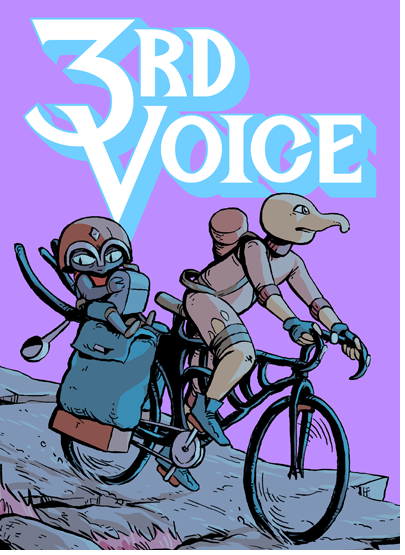
Latest NewsLatest Letter ColumnHi Evan, I have recently been toying with the idea of fantasy writing, and as a supporter of your belief in anti-literalism-in-genre-fiction, anti-worldbuilding-not-driven-by-storytelling, etc, I have a newfound appreciation for your ability to do this in a pulpy, secondary-world setting. Within this I guess what I’m most curious about is if you have any considerations about when to borrow concepts from real life versus when to invent something for your setting, as well as when to ignore or draw attention to something being either realistic or invented. Spondule’s bike, for example: the encyclopedia refers to it as a strange vehicle of 2 wheels, attesting to bikes not being "a thing" in the setting like how they are in real life. Maybe they were a thing in some previous civilisation doomed to salvage, or maybe it was a once-off invention by John Bicycle that never took off -- but, because it’s owned by a Gleaner, we effectively don’t have to know, because it doesn’t matter to the story. And because the comic dialogue is implicitly translated from a fictional language to English, you have the flexibility to refer to it in the text as a bike without the etymological concerns of whether this thing would be known as a bike in-universe, because the people calling it a bike could in actuality be saying anything. All of this seems quite strategically advantageous since it gives you a convenient mode of transport for your main characters, both without leaning on surrealism like Rice Boy did (not that there’s anything wrong with that, it’s just a different tone), and without spending a single word justifying its presence in-universe, which a worldbuilding-before-storytelling narrative might feel obliged to do. So, was this deliberate? Do you feel enabled in any way by 3rd Voice being in a visual medium, given that you can just draw a bike in your invented setting without having to refer to it via written narration (which might pose further conundrums)? Also, contrast with the tea from the 2nd passage, which 1) is explicitly translated to tea from the fictional word for it, 2) has explicitly different effects to real-life tea, yet 3) societally serves a similar function to real-life tea, which is vital to the passage given how much of it centres on socialites in coffeehouses. Is there a logic to when you choose to translate things? Does it become more important to define Capital Tea as "a thing" that an upper class like the Last Capital’s would reasonably use in a similar way to real-life tea (in one sense establishing a "parallel evolution" for it) because of its centrality to the narrative? How much of Capital Tea’s difference to real-life tea is motivated by getting the reader to relate to Spondule and Navichet’s alienation from the upper crust? Excuse the hyperspecification on just these two examples, I just realised how much there was to glean from them alone. Bailey * February 5, 2026 This is not as deliberate on my part as you identify here… Broadly though I’ve gotten to a place with invented-world-fiction where I am extremely preoccupied with the “how is it conveyed to the reader” part of the equation; like I think I treat that as just as important as the “what the fictional setting actually is” part of the equation. What this means to me is: no matter how convoluted and fascinating the setting is, it really only MATTERS when it interfaces with a reader reading about it from the perspective of “the real world.” Reasonably anticipating that this will be the case, the ideal seems to be to work with the assumptions and familiarities of a person living in “the real world,” and to lean on and manipulate those familiarities to articulate the bigger and weirder stuff. Something like that?!!?? (I DO kind of see this as tied inextricably to comics as such, though the principles seem generalizable. Drawing in comics (as i think of it) is built around LEGIBILITY at every possible level… how can I design this character to make self-evident aspects of themself? how can I manipulate/exaggerate the pose of this character to make as clear as possible what they’re doing, and in what way? how can i design this setting to make self-evident certain aspects of itself, so I don’t have to devote time to Explaining them? And so on. This is basically another way of prioritizing the “how is it conveyed to the reader” idea!) So anyway yes the BIKE is a conspicuously real-worldy element in 3V— BUT— every little element of the setting is composed of recontextualized elements of the Real World. There is nothing really actually new and alien in it, because my priority is in making something intelligible. So using a bike as an immediately-legible thing isn’t really qualitatively different from using the million other little conventions and stereotypes we bring to any work of fiction from our perspective as people in the world. Something like that?!?!!? (likewise the TEA example… i want to give a sense automatically about what it is, and the social role it plays… to give it some invented name would really add nothing except a sense of confusion and alienation… which sense IS something i of course consider valuable in some situations though!) I have always been interested in pushing settings further toward the weird and opaque than is normally done, however. It is very frustrating to me how “fantasy” has become a successively locked-in series of predictable genre trappings, to the extent that a lot of modern “fantasy” is more interested in commenting on the genre tradition it’s a part of than anything else. BUT I think that pushing in any more new, weird direction kind of only WORKS if this awareness of legibility is kept in mind? god did I even answer your actual questions here. Anyway thank you for this train of thought |
![]() CALA in Los Angeles, CA. December 13-14, 2025. A livestreamed After Party for the 2nd Passage of 3rd Voice, on twitch December 1 8pm EST. |
![]() |